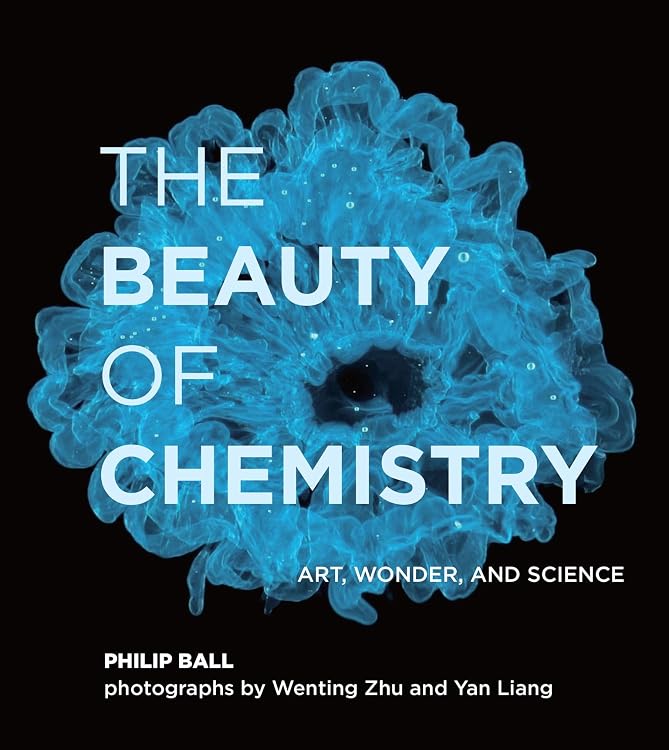
The Beauty of Chemistry: Art, Wonder, and Science
The Beauty of Chemistry: Art, Wonder, and Science is an illustrated introduction to chemistry through natural and everyday phenomena. It uses microphotography, time-lapse photography and infrared thermal imaging to explore subjects including snowflakes, champagne, flowers and chemical gardens.
At a glance
- Illustrates chemistry in phenomena from snowflakes and flower colours to champagne and chemical gardens.
- Features microphotography, time-lapse photography and infrared thermal imaging.
- Connects chemistry with natural processes and everyday materials.
Pros and cons
Pros
- The combination of photographs and explanatory text presents chemistry through visible examples rather than only microscopic concepts.
- Its subjects range from natural formations to processes such as evaporation, distillation and precipitation.
Technical specifications
8 specifications| Publisher | MIT Press |
|---|---|
| Publication date | 11 May 2021 |
| Language | English |
| Print length | 256 pages |
| ISBN-10 | 0262044412 |
| ISBN-13 | 978-0262044417 |
| Weight listed | 1.31 kg |
|---|---|
| Dimensions | 21.3 x 2.8 x 23.8 cm |
Who is it for?
A good fit for
- Readers seeking an image-led introduction to chemistry and its role in nature and daily life.
- Science-curious readers interested in photographic depictions of natural and technological phenomena.
Less suited to
- Readers looking primarily for a chemistry textbook, structured exercises or a technical reference. The supplied description focuses on illustrated explanation and phenomena.
Customer reviews on Amazon
- 5 stars
79% 79% - 4 stars
13% 13% - 3 stars
7% 7% - 2 stars
0% 0% - 1 star
1% 1%
Customer feedback describes the book as a beautiful introduction to chemistry and praises its visuals, including photographs by Wenting Zhu and Yan Liang. The reported interest in real phenomena and imagery suits the book's illustrated approach. Aggregate ratings are generally positive, but do not establish how suitable its depth is for a particular reader.
Positive themes
- Customer feedback praises the book's visual presentation and introductory treatment of chemistry.
Frequently asked questions
What subjects does the book cover?
The listing describes topics including snowflakes, champagne, flower colours, chemical gardens, evaporation, distillation and precipitation.
What kinds of images are used?
The description names microphotography, time-lapse photography and infrared thermal imaging.
Is this a textbook?
The supplied description presents it as an illustrated introduction to chemistry, not as a textbook with exercises or a formal course structure.
Alternative options
The Periodic Table: A Field Guide to the Elements
£12.69
DMSO Without Guesswork: Step-by-Step Dilution Charts and Safe Dosage Protocols to Stop Guessing, Avoid Side Effects, and Relieve Pain & Inflammation Using DMSO
£15.99
Light to Life: The miracle of photosynthesis and how it can save the planet
£9.65
Understanding Science Essential Facts & Exploration: Discover hidden secrets about the world of Physics, Chemistry, Biology, Astronomy, Earth Sciences, and more (Hidden Secrets & Unknown Facts)
£15.99
Chemistry Made Easy: An Illustrated Study Guide For Students To Easily Learn Chemistry
£10.78
The Invisible Lab: 50 Microscopy Experiments You Can Do at Home
£19.99
Fundamentals of General, Organic and Biological Chemistry, SI Edition + Mastering Chemistry with Pearson eText (Package)
£63.92
The Man Who Broke Reality: Niels Bohr and the Making of Modern Physics
£24.09
How Life Works: A User’s Guide to the New Biology
£11.23
Beyond Weird
£10.99
H2O: A Biography of Water
£11.65
Patterns in Nature – Why the Natural World Looks the Way It Does
£22.00