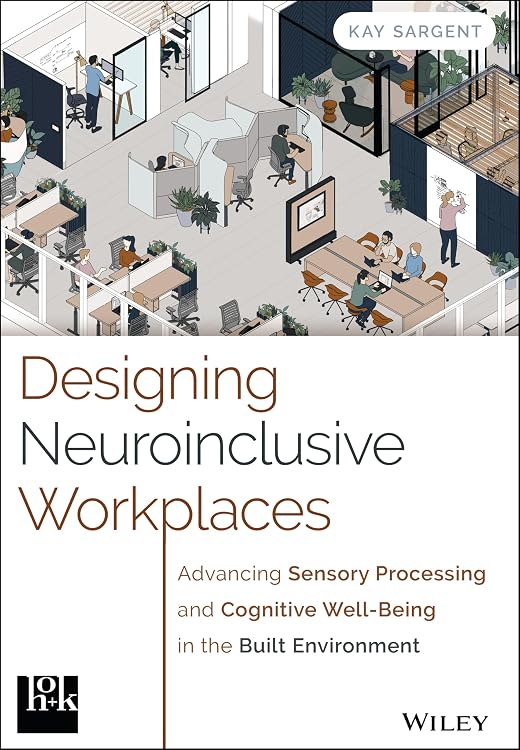
Designing Neuroinclusive Workplaces: Sensory Processing and Cognitive Well-Being
Processing Well-Being: Designing Neuroinclusive Workplaces by Kay Sargent explores ways to shape workplaces around varied sensory and cognitive needs. It discusses spatial zoning, sensory zones, lighting, sound, patterns and textures, with ideas aimed at workplace, HR, DEI, accessibility and design teams.
At a glance
- Covers neuroinclusive approaches to office and workplace design.
- Discusses sensory needs across six work modalities, from focused work to collaboration.
- Topics include spatial zoning and sequencing, lighting, soundscaping, patterns, textures and colours.
- Written by Kay Sargent of HOK.
Pros and cons
Pros
- Connects workplace design decisions with sensory needs and different working modes.
- The stated scope spans practical design topics as well as workplace inclusion practices.
- Relevant to both people shaping workplace policies and professionals designing interiors or buildings.
Technical specifications
9 specifications| Publisher | Wiley |
|---|---|
| Publication date | 20 Mar. 2025 |
| Edition | 1st |
| Language | English |
| Print length | 352 pages |
| ISBN-10 | 1394309333 |
| ISBN-13 | 978-1394309337 |
| Weight listed | 517 g |
|---|---|
| Dimensions | 16.26 x 3.3 x 23.11 cm |
Who is it for?
A good fit for
- HR, DEI and accessibility teams exploring workplace inclusion.
- Architects and interior designers interested in neuroinclusive workplace planning.
- Readers seeking ideas about sensory-aware spaces and varied work modalities.
Less suited to
- Readers looking for a technical building-standard manual or a narrowly focused guide to one sensory condition.
Customer reviews on Amazon
- 5 stars
81% 81% - 4 stars
0% 0% - 3 stars
0% 0% - 2 stars
0% 0% - 1 star
19% 19%
Aggregate ratings lean positive overall, with a substantial five-star share, but also a notable one-star share. This split suggests opinions are not uniformly favourable. The supplied information does not include review comments, so it cannot establish what readers praised or criticised. Consider whether the book's workplace-design focus matches your needs rather than treating the ratings as evidence of specific content quality.
Frequently asked questions
What does the book cover?
The listing describes workplace design through a neuroinclusive lens, including zoning, sensory zones, lighting, soundscaping, patterns and textures.
Who is the book aimed at?
The listing names HR, DEI and accessibility teams, architects and interior designers as intended readers.
What publication details are listed?
It is a Wiley first edition in English, published on 20 Mar. 2025, with a stated print length of 352 pages.
Alternative options
This is Learning Experience Design: What it is, how it works, and why it matters. (Voices That Matter)
£25.99

The Cognitive Architecture of Mind: How minds form, hold, and reshape the worlds they live in.
£27.82

The Neurodivergent Nest: Designing Safe Spaces for ADHD and Autistic Minds
£11.69

Architecture for Flow: Adaptive Systems with Domain-Driven Design, Wardley Mapping, and Team Topologies (Addison-Wesley Signature Series (Vernon))
£28.19

Beyond the Hammer: A Fresh Approach to Leadership, Culture and Building High Performance Teams
£14.00
The Transparency of Compensation: The Employee Engagement Response (Scott T. Consulting and Compensation Series)
£13.28

AI and the Octopus Organization: Building the Superintelligent Firm
£12.95
The Transparency of Compensation: The Employee Engagement Response (Scott T. Consulting and Compensation Series)
£11.06

The Aesthetics of Thought: How Beauty and Design Silently Rewire the Way You Think
£21.91

Collaborative Software Design: How to Facilitate Domain Modeling Decisions
£40.99